
Little River
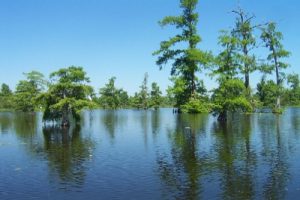 The Little River Bottoms is 18,000 acres of nearly contiguous lowland habitat bounded by AR-355 on the east, the Little River watershed on the south, and Millwood Lake IBA on the west and north. This land is composed of flood-basin swamp, bottomland hardwoods, wetlands, cypress brakes, savannahs, and wetland grassy areas. It is among the largest contiguous tracts of bottomland hardwoods anywhere in the Gulf Coastal Plain of the U.S. The area has been protected by several private hunting clubs as wildlife habitat for over a century. Nacatoch Ravines Natural Area (AR Natural Heritage Commission) and Little River Wildlife Management Area (AR Game & Fish Commission) are part of the IBA.
Within the Little River Bottoms, Grassy Lake and the Yellow Creek drainage have been designated by the Arkansas Pollution Control and Ecology Commission as an “Ecologically Sensitive Waterbody.” Grassy Lake was evaluated by the National Park Service as a potential Natural National Landmark because it “contains the finest example of a sizeable stand of virgin baldcypress in Arkansas.” The Little River Bottoms supports many plant and animal species of conservation concern at the state and continental levels. It has the largest breeding population of American Alligators in Arkansas, supports nationally significant nesting colonies of wading and waterbirds, and contains some of the oldest (> 350 year old) baldcypress trees in Arkansas. The North American Bird Conservation Initiative identified the Little River Bottoms watershed as critical waterfowl and neotropical migrant bird habitat. In general, the biotic diversity of this area is among the greatest of any area or ecosystem in Arkansas.
Red River
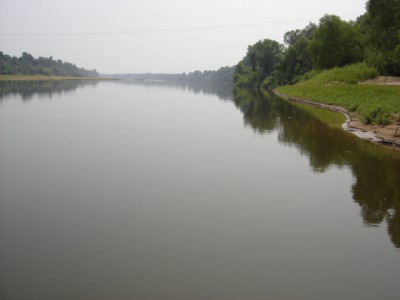 The Red River is one of several rivers with that name. It rises in two branches (forks) in the Texas Panhandle and flows east along the border of Texas and Oklahoma, and briefly between Texas and Arkansas. At Fulton, Arkansas, the river turns south into Louisiana to empty into the Atchafalaya and Mississippi Rivers. The total length of this journey is 1,360 miles (2,190 km). The river gains its name from the red-clay farmland of its watershed. Since 1943 the Red River has been dammed by Denison Dam to form Lake Texoma, a large reservoir of 89,000 acres (360 km²), some 70 miles (110 km) north of Dallas. Other reservoirs serve as flood control on the river’s tributaries. The Red has a mean flow of over 7,000 ft³/s.
Much of the river’s length in Louisiana was unnavigable in the early 19th century because of a collection of fallen trees that formed a “Great Raft” over 160 miles (260 km) long. Captain Henry Miller Shreve cleared the logjam in 1839. The river was thereafter navigable only for small craft north of Natchitoches.
The interest group known as the Red River Valley Association was formed to lobby the United States Congress to make the river fully navigable between Alexandria and Shreveport, Louisiana. Leading supporters of the longstanding project were Louisiana Democratic senators Allen J. Ellender, J. Bennett Johnston, Jr. and Russell B. Long, Louisiana’s former Fourth District Congressman Joseph David “Joe D.” Waggonner, Jr., and the late Shreveport Mayor Littleberry Calhoun Allen, Jr. This project has been completed, and a lock system now allows navigation of barge traffic as far north as Shreveport.
Because of a cartographic error, the land between the north and south forks was claimed by both the state of Texas and the federal government. Originally called Greer County, Texas, the U.S. Supreme Court ruled that it belonged to the federal government, which at the time oversaw the Oklahoma Territory. That territory was later incorporated into the state of Oklahoma, whose southern border now follows the south fork.
That southern fork, which is about 120 miles (190 km), is generally called the Prairie Dog Town Fork. It is formed in Randall County, Texas near the county seat of Canyon, by the confluence of intermittent Palo Duro Creek and Tierra Blanca Creek. (The names mean “Hard Wood” and “White Land”, respectively, in Spanish.) It flows east-southeast, through Palo Duro Canyon in Palo Duro Canyon State Park, then past Newlin, Texas, to meet the Oklahoma state line. From there eastward, it is usually referred to as the Red River, even before meeting the north fork.